| Japanese keelback | |
|---|---|
 | |
Scientific classification  | |
| Domain: | Eukaryota |
| Kingdom: | Animalia |
| Phylum: | Chordata |
| Class: | Reptilia |
| Order: | Squamata |
| Suborder: | Serpentes |
| Family: | Colubridae |
| Genus: | Hebius |
| Species: | H. vibakari |
| Binomial name | |
| Hebius vibakari | |
| Synonyms | |

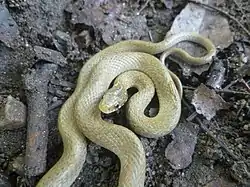
The Japanese keelback (Hebius vibakari) is a species of colubrid snake, which is endemic to Asia.
Geographic range
It is found in northeastern China, Japan (Honshu, Kyushu, Shikoku), Korea, and Russia (Amur Oblast, Khabarovsk Krai, Primorsky Krai).[4]
Description
It is a small snake, growing to a maximum total length of 44 cm (17+1⁄4 in), with a tail 10 cm (3+7⁄8 in) long.
Dorsally it is olive or reddish brown, with small blackish spots. Some specimens may have a dark olive or blackish vertebral stripe. The upper labials are yellow, with black sutures. On each side of the nape of the neck there is a yellow dark-edged diagonal streak, these two streaks converging posteriorly. Ventrally it is yellow, with a series of brown dots or short lines at the outer ends of the ventral scales.
Dorsal scales strongly keeled (except outer row), arranged in 19 rows at midbody. Ventrals 127–151; anal plate divided; subcaudals divided 59–79.[5]
References
- ↑ Borzee, A., Kidera, N., Borkin, L., Orlov, N.L. & Working Group. (2021). "Hebius vibakari". IUCN Red List of Threatened Species. 2021: e.T192162A2049133. Retrieved 20 November 2021.
{{cite journal}}: CS1 maint: multiple names: authors list (link) - ↑ ITIS (Integrated Taxonomic Information System). www.itis.gov.
- ↑ The Reptile Database. www.reptile-database.org.
- ↑ The Reptile Database.
- ↑ Boulenger, G.A. 1893. Catalogue of the Snakes in the British Museum (Natural History). Volume I., Containing the Families...Colubridæ Aglyphæ, Part. Trustees of the British Museum (Natural History). London. xiii + 448 pp. + Plates I.-XXVIII. (Tropidonotus vibakari, pp. 221-222.)
Further reading
- Boie, H. 1826. Merkmale eineger japanischer Lurche. Isis von Oken 19: 203–216. (Tropidonotus vibakari, p. 207.)