Methanobacterium
| Methanobacterium | |
|---|---|
 | |
| Methanobacterium formicicum | |
Scientific classification  | |
| Domain: | Archaea |
| Kingdom: | Euryarchaeota |
| Class: | Methanobacteria |
| Order: | Methanobacteriales |
| Family: | Methanobacteriaceae |
| Genus: | Methanobacterium Kluyver and van Niel 1936 |
| Type species | |
| Methanobacterium formicicum Schnellen 1947 | |
| Species | |
|
See text | |
| Synonyms | |
| |
Methanobacterium, or methanogens, is a genus of the Methanobacteria class in the Archaea kingdom, which produce methane as a metabolic byproduct.[1] Methane gas is a fuel source, but also a greenhouse gas, and a significant contributor to global warming.[2] Despite the name, this genus belongs not to the bacterial domain but the archaeal domain (for instance, they lack peptidoglycan in their cell walls).[3] Methanobacterium are nonmotile and live without oxygen.[4] They are incredibly sensitive to oxygen which means they strictly live in anoxic environments.[2] A shared trait by all methanogens is their ability to cycle products.[2] They can use the products of metabolic activities occurring during methanogenesis as substrates for the formation of methane.[2] Methanobacterium species typically thrive in environments with optimal growth temperatures ranging from 28 to 40 °C, and in versatile ecological ranges.[5] They are a part of the scientific world that is still relatively unknown, but methanogens are thought to be some of earth’s earliest life forms, with origins dating back over 3.4 billion years.[5]
Microbiology
Morphology
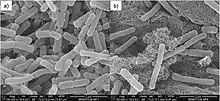
Methanobacteria are generally rod-shaped.[6] Because there are many different species in the Methanobacterium genus, there are a variety of shapes, sizes, and arrangements these microbes can possess.[7] These microbes can be curved, straight, or crooked.[6] They can also range in size, can be short or long, and can be found individually, in pairs, or in chains.[7] Some Methanobacterium species can be found in large clusters or aggregates which consist of long intertwined chains of individual microbes.[8]
Physiology
Methanobacterium are strict anaerobes, meaning they cannot survive in the presence of oxygen.[6] Most species belonging to this genus are also autotrophs which create organic compounds from inorganic materials such as carbon dioxide.[8] Methanobacterium can be classified as hydrogenotrophic methanogens.[8] Hydrogenotrophic methanogens use hydrogen, carbon dioxide, formate, and alcohols to synthesize methane.[8] These substrates are also important for the growth and maintenance of methanobacterium.[8]
History
Methanobacterium are a specific genus within the methanogen species.[9] The evolutionary history of methanobacterium is still relatively unknown, but methanogens are thought to be some of earth’s earliest life forms, with origins dating back over 3.4 billion years.[9]
In 1776, Alesandro Volta discovered that gas bubbles coming from a freshwater swamp were flammable.[10] This finding lead him to believe that methane gas could be produced by living organisms, however, he thought that this methane was coming from decomposing organic matter.[10] In 1993, methanogens were first cultured, revealing that this methane was coming from living organisms.[10]
Examples of Methanobacterium Species
There are many different species of Methanobacterium with officially recognized names.[11] A few and listed and described below:
Methanobacterium formicicum is an archaeon found in the rumen of cattle, buffalo, sheep, goats and other animals.[12] Microbes in the gut, degrade nutrients from feed (polysaccharides, proteins, and fats) into organic molecules which later are turned into methane by methanobacterium such as Methanobacterium formicicum.[12] Methanobacterium formicicum can be found in the human gut as well as in animals and can cause gastrointestinal and metabolic disorders in both humans and animals.[12]
Methanobacterium oryzae was isolated from rice field soil in the Philippines.[13] Methanobacterium, such as Methanobacterium oryzae, that thrive in rice fields often use hydrogen and acetate as their main energy source.[13] This methanobacterium as well as other species of methanobacterium found in rice field soils from around the world are a major source of methane which is a dominant greenhouse gas.[13]
Methanobacterium palustre thrives in marshland areas and was first found in a peat bog.[14]
Methanobacterium arcticum was isolated from permafrost sediments in the Russian Arctic.[11] This species of methanobacterium uses only hydrogen, carbon dioxide, and formate as fuel.[11] Unlike some other methanobacteria, it does not use acetate to grow.[11]
Methanobacterium thermoautotrophicum Marburg can undergo natural genetic transformation, the transfer of DNA from one cell to another.[15] Genetic transformation in archaeal species, generally, appears to be an adaptation for repairing DNA damage in a cell by utilizing intact DNA information derived from another cell.[16]
Phylogeny
The currently accepted taxonomy is based on the List of Prokaryotic names with Standing in Nomenclature (LPSN)[17] and National Center for Biotechnology Information (NCBI).[18]
| 16S rRNA based LTP_08_2023[19][20][21] | 53 marker proteins based GTDB 08-RS214[22][23][24] | ||||||||||||||||||||||||||||||||||||||||||||||||||||||||||||||||||||||||||||||||||||||||||||||||||||||||||||||||||||||||||||||||||||||||||||||||||||||||||||||||||||||||||||||||||||||||||||||||||||||
|---|---|---|---|---|---|---|---|---|---|---|---|---|---|---|---|---|---|---|---|---|---|---|---|---|---|---|---|---|---|---|---|---|---|---|---|---|---|---|---|---|---|---|---|---|---|---|---|---|---|---|---|---|---|---|---|---|---|---|---|---|---|---|---|---|---|---|---|---|---|---|---|---|---|---|---|---|---|---|---|---|---|---|---|---|---|---|---|---|---|---|---|---|---|---|---|---|---|---|---|---|---|---|---|---|---|---|---|---|---|---|---|---|---|---|---|---|---|---|---|---|---|---|---|---|---|---|---|---|---|---|---|---|---|---|---|---|---|---|---|---|---|---|---|---|---|---|---|---|---|---|---|---|---|---|---|---|---|---|---|---|---|---|---|---|---|---|---|---|---|---|---|---|---|---|---|---|---|---|---|---|---|---|---|---|---|---|---|---|---|---|---|---|---|---|---|---|---|---|---|
|
|
Unassigned species:
- "M. cahuitense" Dengler et al. 2023
- "M. curvum" Sun, Zhou & Dong 2001
- "M. propionicum" Stadtman & Barker 1951
- "M. soehngenii" Barker 1936
- "M. suboxydans" Stadtman & Barker 1951
- M. thermaggregans
- M. uliginosum König 1985
See also
References
- ↑ "Supplemental Information 3: Taxon list extracted from taxonomic sources, with corresponding NCBI taxonomy identifiers by which NCBI sequence accessions were filtered". dx.doi.org. Retrieved 29 February 2024.
- 1 2 3 4 Schaechter, Moselio (2009). Encyclopedia of microbiology (3rd ed.). Amsterdam Boston: Elsevier/Academic Press. ISBN 978-0-12-373944-5.
- ↑ Whitman, William B., ed. (14 September 2015). Bergey's Manual of Systematics of Archaea and Bacteria (1 ed.). Wiley. doi:10.1002/9781118960608.gbm00495. ISBN 978-1-118-96060-8.
- ↑ Whitman, William B., ed. (14 September 2015). Bergey's Manual of Systematics of Archaea and Bacteria (1 ed.). Wiley. doi:10.1002/9781118960608.gbm00495. ISBN 978-1-118-96060-8.
- 1 2 Lv, Zhenbo; Ding, Jiaxin; Wang, Heng; Wan, Jiaxin; Chen, Yifan; Liang, Lewen; Yu, Tiantian; Wang, Yinzhao; Wang, Fengping (October 2022). "Isolation of a Novel Thermophilic Methanogen and the Evolutionary History of the Class Methanobacteria". Biology. 11 (10): 1514. doi:10.3390/biology11101514. ISSN 2079-7737.
- 1 2 3 Whitman, William B., ed. (14 September 2015). Bergey's Manual of Systematics of Archaea and Bacteria (1 ed.). Wiley. doi:10.1002/9781118960608.gbm00495. ISBN 978-1-118-96060-8.
- 1 2 "Midas Field Guide". midasfieldguide.org. Retrieved 14 March 2024.
- 1 2 3 4 5 Kern, Tobias; Linge, Mary; Rother, Michael (1 June 2015). "Methanobacterium aggregans sp. nov., a hydrogenotrophic methanogenic archaeon isolated from an anaerobic digester". International Journal of Systematic and Evolutionary Microbiology. 65 (Pt_6): 1975–1980. doi:10.1099/ijs.0.000210. ISSN 1466-5026.
- 1 2 Lv, Zhenbo; Ding, Jiaxin; Wang, Heng; Wan, Jiaxin; Chen, Yifan; Liang, Lewen; Yu, Tiantian; Wang, Yinzhao; Wang, Fengping (16 October 2022). "Isolation of a Novel Thermophilic Methanogen and the Evolutionary History of the Class Methanobacteria". Biology. 11 (10): 1514. doi:10.3390/biology11101514. ISSN 2079-7737. PMC 9598358. PMID 36290418.
- 1 2 3 Buan, Nicole R. (14 December 2018). Robinson, Nicholas P. (ed.). "Methanogens: pushing the boundaries of biology". Emerging Topics in Life Sciences. 2 (4): 629–646. doi:10.1042/ETLS20180031. ISSN 2397-8554. PMC 7289024.
- 1 2 3 4 Shcherbakova, Viktoria; Rivkina, Elizaveta; Pecheritsyna, Svetlana; Laurinavichius, Kestus; Suzina, Nataliya; Gilichinsky, David (1 January 2011). "Methanobacterium arcticum sp. nov., a methanogenic archaeon from Holocene Arctic permafrost". International Journal of Systematic and Evolutionary Microbiology. 61 (1): 144–147. doi:10.1099/ijs.0.021311-0. ISSN 1466-5026.
- 1 2 3 Chellapandi, P; Bharathi, M; Sangavai, C; Prathiviraj, R (December 2018). "Methanobacterium formicicum as a target rumen methanogen for the development of new methane mitigation interventions: A review". Veterinary and Animal Science. 6: 86–94. doi:10.1016/j.vas.2018.09.001. ISSN 2451-943X. PMC 7386643. PMID 32734058.
- 1 2 3 Joulian, C; Patel, B K; Ollivier, B; Garcia, J L; Roger, P A (1 March 2000). "Methanobacterium oryzae sp. nov., a novel methanogenic rod isolated from a Philippines ricefield". International Journal of Systematic and Evolutionary Microbiology. 50 (2): 525–528. doi:10.1099/00207713-50-2-525. ISSN 1466-5026. PMID 10758856.
- ↑ Zellner, G.; Bleicher, K.; Braun, E.; Kneifel, H.; Tindall, B. J.; de Macario, E. Conway; Winter, J. (December 1988). "Characterization of a new mesophilic, secondary alcohol-utilizing methanogen, Methanobacterium palustre spec. nov. from a peat bog". Archives of Microbiology. 151 (1): 1–9. doi:10.1007/BF00444660. ISSN 0302-8933.
- ↑ Worrell VE, Nagle DP Jr, McCarthy D, Eisenbraun A. Genetic transformation system in the archaebacterium Methanobacterium thermoautotrophicum Marburg. J Bacteriol. 1988 Feb;170(2):653-6. doi: 10.1128/jb.170.2.653-656.1988. PMID 3422229; PMCID: PMC210704
- ↑ Bernstein H, Bernstein C. Sexual communication in archaea, the precursor to meiosis. pp. 103–117 in Biocommunication of Archaea (Guenther Witzany, ed.) 2017. Springer International Publishing
- ↑ J.P. Euzéby. "Methanobacterium". List of Prokaryotic names with Standing in Nomenclature (LPSN). Retrieved 23 February 2022.
- ↑ See the NCBI webpage on Methanobacterium. Data extracted from the "NCBI taxonomy resources". National Center for Biotechnology Information. Retrieved 19 March 2007.
- ↑ "The LTP". Retrieved 20 November 2023.
- ↑ "LTP_all tree in newick format". Retrieved 20 November 2023.
- ↑ "LTP_08_2023 Release Notes" (PDF). Retrieved 20 November 2023.
- ↑ "GTDB release 08-RS214". Genome Taxonomy Database. Retrieved 10 May 2023.
- ↑ "ar53_r214.sp_label". Genome Taxonomy Database. Retrieved 10 May 2023.
- ↑ "Taxon History". Genome Taxonomy Database. Retrieved 10 May 2023.