Mogamulizumab
| Monoclonal antibody | |
|---|---|
| Type | Whole antibody |
| Source | Humanized (from mouse) |
| Target | CCR4 |
| Names | |
| Pronunciation | moe gam" ue liz' ue mab |
| Trade names | Poteligeo |
| Other names | Mogamulizumab-kpkc |
| Clinical data | |
| Main uses | Mycosis fungoides, Sézary disease[1][2] |
| Side effects | Rash, pneumonia, fever, cellulitis[2] |
| WHO AWaRe | UnlinkedWikibase error: ⧼unlinkedwikibase-error-statements-entity-not-set⧽ |
| Pregnancy category | |
| Routes of use | Intravenous |
| External links | |
| AHFS/Drugs.com | Monograph |
| MedlinePlus | a618064 |
| Legal | |
| License data | |
| Legal status | |
| Chemical and physical data | |
| Formula | C6520H10072N1736O2020S42 |
| Molar mass | 146444.95 g·mol−1 |
Mogamulizumab, sold under the brand name Poteligeo, is a medication used to treat mycosis fungoides and Sézary disease.[1][2] It is used when other treatments are not effective.[1] It is given by gradual injection into a vein.[1]
Common side effects include rash, pneumonia, fever, and cellulitis.[2] Other side effects may include Stevens-Johnson syndrome, sepsis, pneumonitis, myocarditis, and polymyositis.[1] Use in pregnancy may harm the baby.[1] It is a monoclonal antibody that binds to CC chemokine receptor 4 (CCR4) found on white blood cells.[2]
Mogamulizumab was approved for medical use in the United States and Europe in 2018.[1][2] In the United Kingdom 4 mg cost the NHS about £1,300 as of 2021.[5] This amount in the United States costs about 4,200 USD.[6]
Medical uses
It was approved in Japan in 2012, for the treatment of relapsed or refractory CCR4+ adult T-cell leukemia/lymphoma (ATCLL) and in 2014, for relapsed or refractory CCR4+ cutaneous T cell lymphoma (CTCL).[7] The latter approval was based on study with 28 subjects.[8]
Dosage
It is given at a dose of 1 mg/kg once a week for 4 weeks than once every two weeks.[5]
Mechanism of action
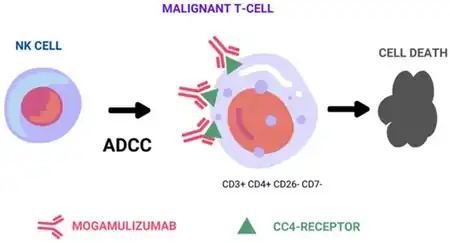
In terms of the mode of action of Mogamulizumad we find that it targets CCR4 that is found on surface of T-cell lymphocytes(some T cells become cancerous). Mogamulizumab attracts the immune system to attack the cancerous T cells. Additionally, it blocks the signals that CCR4 sends inside cells, which are signals that help the T cells to survive and multiply.[9]
History
The precursor to mogamulizumab was a mouse anti-human CCR4 IgG1 mAb (KM2160), that was made in 1996 in a collaboration between Kouji Matsushima of University of Tokyo and Kyowa Hakko Kirin. Kyowa humanized it, and expressed the humanized gene in a CHO cell line in which FUT8 had been knocked out, which produced antibodies with no fucose in the Fc region.[7] [10] This is thought to enhance its antibody-dependent cell-mediated cytotoxicity.[11] It was first tested in humans in 2007.[10]
Kyowa licensed rights for use outside of cancer to Amgen in 2008, for $100 million up front and $420 million in biodollars.[12] Amgen ran a Phase I study to explore its use in asthma.[13] Amgen terminated the agreement in 2014.[12]
As of 2014, there were reports that mogamulizimab can cause serious skin rashes and some cases of Stevens–Johnson syndrome.[13]
In 2017, the US FDA granted it a priority review for CTCL.[14] Full approval was granted in August 2018.[15] The U.S. Food and Drug Administration (FDA) considers it to be a first-in-class medication.[16]
Research
Mogamulizumab is being explored as a treatment for HTLV-1–Associated Myelopathy. An early Phase 1-2a study showed decreased in proviral loads, as well as inflammatory markers in the CSF. 79% of the patients showed reduction in spasticity and 32% showed decrease in motor disability.[17]
References
- 1 2 3 4 5 6 7 "Mogamulizumab-kpkc Monograph for Professionals". Drugs.com. Archived from the original on 6 August 2020. Retrieved 18 November 2021.
- 1 2 3 4 5 6 "Poteligeo". Archived from the original on 5 July 2021. Retrieved 18 November 2021.
- 1 2 "Poteligeo". Therapeutic Goods Administration (TGA). 15 February 2021. Archived from the original on 9 September 2021. Retrieved 8 September 2021.
- 1 2 "AusPAR: Mogamulizumab". Therapeutic Goods Administration (TGA). 10 May 2021. Archived from the original on 9 September 2021. Retrieved 8 September 2021.
- 1 2 BNF 81: March-September 2021. BMJ Group and the Pharmaceutical Press. 2021. p. 920. ISBN 978-0857114105.
- ↑ "Poteligeo Prices, Coupons & Patient Assistance Programs". Drugs.com. Archived from the original on 11 April 2021. Retrieved 18 November 2021.
- 1 2 Yu X, Marshall MJ, Cragg MS, Crispin M (June 2017). "Improving Antibody-Based Cancer Therapeutics Through Glycan Engineering" (PDF). BioDrugs. 31 (3): 151–166. doi:10.1007/s40259-017-0223-8. PMID 28466278. S2CID 3722081. Archived (PDF) from the original on 2021-08-26. Retrieved 2021-09-09.
- ↑ Broccoli A, Argnani L, Zinzani PL (November 2017). "Peripheral T-cell lymphomas: Focusing on novel agents in relapsed and refractory disease". Cancer Treatment Reviews. 60: 120–129. doi:10.1016/j.ctrv.2017.09.002. PMID 28946015.
- 1 2 Fernández-Guarino, Montserrat; Ortiz, Pablo; Gallardo, Fernando; Llamas-Velasco, Mar (January 2024). "Clinical and Real-World Effectiveness of Mogamulizumab: A Narrative Review". International Journal of Molecular Sciences. 25 (4): 2203. doi:10.3390/ijms25042203. ISSN 1422-0067. Archived from the original on 2024-02-15. Retrieved 2024-05-13.
- 1 2 Ueda R (2015). "Clinical Application of Anti-CCR4 Monoclonal Antibody". Oncology. 89 Suppl 1: 16–21. doi:10.1159/000431059. PMID 26550987. S2CID 24091636.
- ↑ "Available Agents: Mogamulizumab". NCI Formulary. Archived from the original on 11 May 2018. Retrieved 11 May 2018.
- 1 2 Carroll J (August 25, 2017). "After a long clinical odyssey, the FDA tapped this PhIII anti-CCR4 as a 'breakthrough' lymphoma drug". Endpoints. Archived from the original on October 31, 2021. Retrieved September 9, 2021.
- 1 2 Pease JE, Horuk R (May 2014). "Recent progress in the development of antagonists to the chemokine receptors CCR3 and CCR4". Expert Opinion on Drug Discovery. 9 (5): 467–83. doi:10.1517/17460441.2014.897324. PMID 24641500. S2CID 32596704.
- ↑ Adamson L (22 January 2018). "Mogamulizumab Receives Priority Review for CTCL - ASH Clinical News". ASH Clinical News. Archived from the original on 10 May 2018. Retrieved 9 September 2021.
- ↑ "FDA approves treatment for two rare types of non-Hodgkin lymphoma" (Press release). Archived from the original on 2021-07-15. Retrieved 2021-09-09.
- ↑ New Drug Therapy Approvals 2018 (PDF). U.S. Food and Drug Administration (FDA) (Report). January 2019. Archived from the original on 17 September 2020. Retrieved 16 September 2020.
- ↑ Sato T, Coler-Reilly AL, Yagishita N, Araya N, Inoue E, Furuta R, et al. (February 2018). "Mogamulizumab (Anti-CCR4) in HTLV-1-Associated Myelopathy". The New England Journal of Medicine. 378 (6): 529–538. doi:10.1056/NEJMoa1704827. PMID 29414279.
External links
| External sites: |
|
|---|---|
| Identifiers: |


- "Mogamulizumab-kpkc". National Cancer Institute. 30 August 2018. Archived from the original on 9 July 2021. Retrieved 9 September 2021.
- "Mogamulizumab-kpkc". NCI Drug Dictionary. National Cancer Institute. Archived from the original on 2021-07-22. Retrieved 2021-09-09.