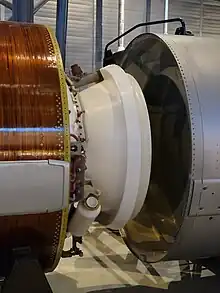
Interstage of the UGM-73 Poseidon missile. First stage is on the right, separated second stage - on the left
In rocketry, an adapter is a hollow cylindrical[1] or conical segment[2] which provides a sound aerodynamic and structural connection, either between rocket stages (referred to as an interstage adapter) or between a spacecraft and the top rocket stage (referred to as a payload adapter). It may shroud and protect vulnerable systems such as electrics or machinery of rocket engines/spacecraft from weather or noise caused by running engines. It is discarded during staging.
Examples of Rocket Stages featuring an interstage adapter:
- Centaur (Second Stage of several Atlas-based launch vehicles, from Atlas-Centaur to Atlas V)[3][4][5]
- S-II and S-IVB (Second and third stage of the Saturn V)[6][7]
- The Interim Cryogenic Propulsion Stage (ICPS) of SLS Block 1 is connected to the Core Stage with the Launch Vehicle Stage Adapter (LVSA)[8]
Examples of Rocket Stages featuring a payload adapter:
- (Planned) The Exploration Upper Stage (EUS) is expected to connect large secondary co-manifested payloads SLS Block 1B/2 using the Universal Stage Adapter (USA).[9]
References
- ↑ Smith 2002, p. 2.
- ↑ Wiley J. Larson; Linda K. Pranke (1999). Human Spaceflight: Mission Analysis and Design. McGraw-Hill. ISBN 978-0-07-236811-6.
- ↑ "The Launch of Atlas-Centaur 5". 2 March 2015.
- ↑ "Centaur - Mission Planners Guide (NASA CR-154970)" (PDF). General Dynamics Convair Aerospace Division. 1 August 1971. Archived (PDF) from the original on 8 January 2022.
- ↑ "Atlas Launch System Mission Planner's Guide, Atlas V Addendum (AVMPG)" (PDF). Lockheed Martin. 1 December 1999.
- ↑ McCutcheon, Kimble D. (3 August 2022). "U.S. Manned Rocket Propulsion Evolution Part 8.20: The Saturn V S-II".
- ↑ McCutcheon, Kimble D. (3 August 2022). "U.S. Manned Rocket Propulsion Evolution Part 8.30: The Saturn S-IVB Stage".
- ↑ "NASA's Space Launch System Launch Vehicle Stage Adapter Ready for Thermal Insulation Application". 30 August 2017. Retrieved 14 September 2022.
- ↑ "Universal Stage Adapter (USA)". Retrieved 14 September 2022.
Sources
- Smith, John (2002-07-07). Evolved Composite Structures for Atlas V. Reston, Virigina: American Institute of Aeronautics and Astronautics. doi:10.2514/6.2002-4201.
This article is issued from Wikipedia. The text is licensed under Creative Commons - Attribution - Sharealike. Additional terms may apply for the media files.