| Alticonodon | |
|---|---|
Scientific classification  | |
| Domain: | Eukaryota |
| Kingdom: | Animalia |
| Phylum: | Chordata |
| Class: | Mammalia |
| Clade: | †Eutriconodonta |
| Family: | †Triconodontidae |
| Subfamily: | †Alticonodontinae |
| Genus: | †Alticonodon Fox, 1969 |
| Species: | †A. lindoei |
| Binomial name | |
| †Alticonodon lindoei Fox, 1969 | |
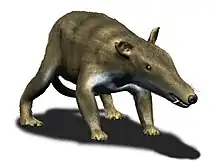
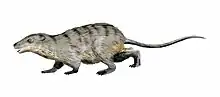
Alticonodon is a genus of extinct mammal from the Late Cretaceous of North America. It is the geologically youngest known eutriconodont, and is a fairly more specialised animal than earlier representatives of this clade.[1]
Description
Alticonodon is currently a monotypic genus, represented exclusively by A. lindoei. It is known from the Milk River Formation deposits of the early Campanian of Alberta, Canada. It is known from two specimens: a dentary fragment bearing two molars, and an isolated lower last molar.
Classification
Alticonodon has been consistently recovered as a triconodontid, and more specifically as an alticonodontine,[2] though the latter term may be redundant in relation to the rest of Triconodontidae.[3]
Biology
Compared to earlier eutriconodonts, Alticonodon has molars better specialised for shearing.[1] As eutriconodonts as a group had shearing molars due to their carnivorous habits,[4] it can be inferred that Alticonodon was hypercarnivorous.
This ecological specialisation might have come due to competition with other mammals in the region, such as the various metatherians.[1]
Ecology
The Milk River Formation is a rich fossil environment that covered near-shore and terrestrial deposits. It included a few dinosaur species like Saurornitholestes and Acrotholus, as well as a variety of other vertebrate such as the crocodilian Gilchristosuchus, various turtles and fish.
The mammalian fauna was primarily dominated by metatherians and multituberculates, as usual for Late Cretaceous mammaliafaunas, but a variety of older taxa remained; besides Alticonodon, there was also the symmetrodont Symmetrodontoides, and Potamotelses and picopsids. These were the last non-therian mammals (other than the highly successful multituberculates) in North America, suggesting a relictual element to the region's fauna.
References
- 1 2 3 R. C. Fox. 1969. Studies of Late Cretaceous vertebrates. III. A triconodont mammal from Alberta. Canadian Journal of Zoology 47:1253-1256
- ↑ L. C. Gaetano and G. W. Rougier. 2011. New materials of Argentoconodon fariasorum (Mammaliaformes, Triconodontidae) from the Jurassic of Argentina and its bearing on triconodont phylogeny. Journal of Vertebrate Paleontology 31(4):829-843 [R. Benson/R. Benson]
- ↑ Thomas Martin, Jesús Marugán-Lobón, Romain Vullo, Hugo Martín-Abad, Zhe-Xi Luo & Angela D. Buscalioni (2015). A Cretaceous eutriconodont and integument evolution in early mammals. Nature 526, 380–384. doi:10.1038/nature14905
- ↑ Zofia Kielan-Jaworowska, Richard L. Cifelli, Zhe-Xi Luo (2004). "Chapter 7: Eutriconodontans". Mammals from the Age of Dinosaurs: origins, evolution, and structure. New York: Columbia University Press. pp. 216–248. ISBN 0-231-11918-6.