| 内閣情報調査室 Naikaku Jōhō Chōsashitsu (Naichō) | |
 Seal of the Cabinet Intelligence and Research Office | |
| Agency overview | |
|---|---|
| Formed | 1986 (CIRO establishment) |
| Preceding agencies | |
| Jurisdiction | Government of Japan |
| Headquarters | Nagatacho, Tokyo, Japan |
| Employees | 170–175 |
| Agency executive |
|
| Parent agency | Cabinet Secretariat |
| Website | www |
The Cabinet Intelligence and Research Office (内閣情報調査室, Naikaku Jōhō Chōsashitsu),[3] also known as Naichō (内調), is a Japanese intelligence agency under the Cabinet Secretariat responsible for gathering, processing, and analyzing national security information for the cabinet. As a principal member of the Japanese intelligence community, the CIRO reports directly to the Prime Minister. Its operations are mandated through the Cabinet Law.[4]
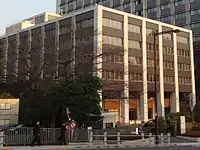
The agency is said to be an equal to the American Central Intelligence Agency.[5] Like most intelligence agencies in Japan, its personnel are usually recruited from other agencies.[6] Around 100 out of 170 CIRO agents are from other agencies/ministries with top positions occupied by career police officers.[7] The CIRO frequently works with the National Security Council as a communication channel to the prime minister. The CIRO is headquartered in Chiyoda, Tokyo, in a building called "H20".[8]
History
The CIRO was created by the Allied Forces through the formation of the Prime Ministers's Research Office (内閣総理大臣官房調査室, Naikakusōri Daijin Kanbō Chōsa-Shitsu)[2] in April 1952 with Jun Murai as the first director in an attempt to replicate its structure after the CIA.[7] But due to widespread opposition and the factionalism in the bureaucracy, this plan was discarded.[7] The RO was placed under jurisdiction of the Prime Minister's office in 1957 and was known as the Cabinet Research Office (内閣調査室, Naikaku Chōsa-Shitsu).[1] The CRO was later renamed as the CIRO in 1986.[1]
The Cabinet Intensive Information Center was established on April 11, 1996 to ensure that the CIRO can inform the Prime Minister in case of severe emergencies.[5] It's located in the Prime Minister's residence.[5]
In August 2007, discussions of intelligence reforms through the paper Improvement of Counter-Intelligence Functions resulted in the establishment of the Counterintelligence Center.[9] It's been suggested that the CIC can be used as the basis for the creation of an actual external intelligence agency similar to the CIA.[10]
In 2013, CIRO satellite imagery analysis was used to assist NGOs in Tacloban for reconstruction work in the wake of Typhoon Haiyan.[11]
Since 2015, CIRO agents are usually recruited to be sent to the International Counter-Terrorism Intelligence Collection Unit.[12][13]
In 2016, the business magazine Facta reported that the government of Shinzo Abe had directed the CIRO to spy on a legal council connected to David Kaye, who as U.N. special rapporteur on freedom of expression stated "deep and genuine concern" on declining media independence in Japan.[14]
Spy scandal
On January 17, 2008, an official of Naichō was charged for spying for Russians, passing them classified information. The Russians denied the claim.[15] Since then, there had been calls for greater accountability on Naichō.[16]
Organization
According to its official web site, organization of Naichō is as follows:[17]
- Director of Cabinet Intelligence (内閣情報官)
- Deputy Director of Cabinet Intelligence (次長)
- Cabinet Intelligence Officer
- Divisions:
- Administration (総務部門): Has Human Resources, Budget and academic experts.
- Home Affairs Division (国内部門): Collect information based on domestic media, including newspapers, magazines and from news broadcasts.
- International Affairs Division (国際部門): Collect information based on foreign media and broadcasts from another country, including CIRO agents based overseas.
- Economic Affairs Division (経済部門): Studies domestic/international economic information.
- Cabinet Intensive Information Center (内閣情報集約センター): Secures information related to disasters and other emergencies. Staffed by twenty agents from the Ministry of Defense, National Police Agency, Fire Disaster and Management Agency and the Japan Coast Guard.
- Cabinet Intelligence Analysts (内閣情報分析官)
- Cabinet Satellite Intelligence Center (内閣衛星情報センター): Operates a network of surveillance satellites, such as the IGS-Optical and IGS-Radar series. As of June 2018, Japan has six functioning observation satellites in orbit.[18] It was established in 2001 and has 320 personnel employed with at least 100 of them being imagery intelligence analysts.[7] Tasked with obtaining and analyzing satellite imagery data.[19] The Deputy Director position is filled by a senior officer from the NPA.[20]
- Situation Center of Cabinet
- National Counterintelligence Center (カウンターインテリジェンスセンター): Coordinates government action based on the "Improvement of Counter-Intelligence Functions" policy.
- Cabinet Counter Terrorism Intelligence Coordination Center
Directors of Naichō
- Yoshio Omori[21]
- Kazuhiro Sugita (January 2001 – April 2001)[22]
- Toshinori Kanemoto (April 2001 – April 2006)[23]
- Hideshi Mitani (April 2006 – April 2010)[24]
- Shinichi Uematsu (April 2010 – December 2011)[25]
- Shigeru Kitamura (December 2011 – September 2019)[8][26]
- Hiroaki Takizawa (September 2019 – June 2023)[27][28]
- Kazuya Hara (June 2023 – present)[29]
References
- 1 2 3 4 "JAPAN'S NATIONAL SECURITY POLICY INFRASTRUCTURE - CAN TOKYO MEET WASHINGTON'S EXPECTATION?" (PDF). stimson.org. November 2008.
- 1 2 "Intelligence in the New Japan — Central Intelligence Agency". Archived from the original on 2008-03-12.
- ↑ "Names of Government Organizations and Positions" (PDF). Cabinet Secretariat. Retrieved 2013-12-20.
- ↑ "The Cabinet Law".
- 1 2 3 Andrew Oros (2008-06-09). "Japan's Growing Intelligence Capabilities" (PDF). Archived from the original (PDF) on 2009-03-20. Retrieved 2019-05-23.
- ↑ "Abe administration considering creating MI6-style spy agency". 6 March 2015.
- 1 2 3 4 Davis and Gustafson, page. 183.
- 1 2 Gallagher, Ryan (May 19, 2018). "The Untold Story of Japan's Secret Spy Agency". Archived from the original on May 21, 2018.
- ↑ Davis and Gustafson, page. 188.
- ↑ 窪田順生 『スピンドクター モミ消しのプロが駆使する「情報操作」の技術』 講談社+α新書 p.101
- ↑ "2013年11月 フィリピン台風被災状況推定地図 タクロバン周辺全体" (PDF). cas.go.jp.
- ↑ Tatsumi, Yuki. "To Fight Terror, Japan Must Fix Its Intelligence Apparatus". The Diplomat. Archived from the original on 2015-06-03.
- ↑ "Japan's counterterrorism efforts falling short". 5 March 2016. Archived from the original on 2016-03-09.
- ↑ Fackler, Matthew (27 May 2016). "The Silencing of Japan's Free Press". Foreign Policy (published 2016-05-27). Archived from the original on 2016-06-02. Retrieved 2023-04-10.
- ↑ "A Japanese Faces Spy Charges". The Moscow Times. Archived from the original on January 21, 2008. Retrieved 2008-01-17.
- ↑ "Japan's Cabinet urges tighter controls amid Russian spy scandal". Retrieved 2009-06-24.
- ↑ "Organizational Structure | Cabinet Secretariat".
- ↑ "Japan Places Eighth Reconnaissance Satellite in Orbit – Via Satellite -". Via Satellite. 13 June 2018.
- ↑ "Briefing Memo" (PDF). nids.go.jp. May 2006. Archived from the original (PDF) on 25 June 2008. Retrieved 31 May 2023.
- ↑ Dover, Goodman and Hillebrand, page 203
- ↑ "Japan's sports intelligence can help national-level gathering capabilities". Archived from the original on 2023-04-09.
- ↑ 内閣危機管理監 (in Japanese). Cabinet Secretariat. Retrieved 2011-02-27.
- ↑ 内閣情報官 (in Japanese). Cabinet Secretariat. Retrieved 2011-02-27.
- ↑ 内閣情報官 (in Japanese). Cabinet Secretariat. Retrieved 2011-02-27.
- ↑ 内閣情報官 (in Japanese). Cabinet Secretariat. Archived from the original on 2011-03-22. Retrieved 2011-02-27.
- ↑ "Top Intelligence Post Vacant". Japan Security Watch. Archived from the original on 2016-11-12. Retrieved 2017-01-20.
- ↑ "国家安全保障局長に北村滋氏 谷内氏退任、後任内閣情報官は滝沢氏". 11 September 2019.
- ↑ "内閣情報官 瀧澤 裕昭(たきざわ ひろあき)|内閣官房ホームページ".
- ↑ "政府 内閣情報官に警察庁 原和也警備局長を起用". NHK. 27 June 2023. Retrieved 28 August 2023.
Bibliography
- Davies, Philip H.J.; Gustafson, Kristian, eds. (2013). Intelligence Elsewhere: Spies and Espionage Outside the Anglosphere. Georgetown University Press. ISBN 978-1589019560.
- Dover, Robert; Goodman, Michael S.; Hillebrand, Claudia, eds. (2014). Routledge Companion to Intelligence Studies. New York: Routledge. ISBN 978-1589019560.
- Samuels, Richard J. (2019). Special Duty: A History of the Japanese Intelligence Community. Cornell University Press. ISBN 978-1501741586.
External links
- Official website (in Japanese)
- Official website (in English)

 Japanese intelligence agencies Japanese intelligence agencies | |
|---|---|
| Cabinet Intelligence Council |
|
| Cabinet Office | |
| Ministry of Foreign Affairs |
|
| Ministry of Defense |
|
| Police organizations | |
| Ministry of Justice | |
| Japan Coast Guard |
|
| Ministry of Finance |
|
| Defunct agencies |
|