| Great Basin wood-nymph | |
|---|---|
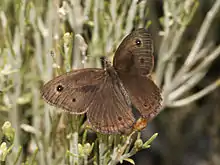 | |
| Cercyonis sthenele paulus, male | |
Scientific classification  | |
| Domain: | Eukaryota |
| Kingdom: | Animalia |
| Phylum: | Arthropoda |
| Class: | Insecta |
| Order: | Lepidoptera |
| Family: | Nymphalidae |
| Genus: | Cercyonis |
| Species: | C. sthenele |
| Binomial name | |
| Cercyonis sthenele (Boisduval, 1852) | |
| Synonyms | |
| |

Cercyonis sthenele, the Great Basin wood-nymph, is a North American butterfly in the family Nymphalidae.
Description
It is dark brown with two eyespots on the forewing with the upper larger than the lower.[3]
The wingspan measures 39–44 mm (1.5–1.7 in). Its flight period is from late June to late August.[4] It is found in arid woodland, especially pinyon-juniper, chaparral and brushland habitats.[1]
Similar species
- Common wood-nymph (Cercyonis pegala) – larger, eyespots similar in size
- Small wood-nymph (Cercyonis oetus) – lacks lower eyespot in males, lower eyespot is closer to margin than upper eyespot in females[4]
Subspecies
The following subspecies are recognised:[5]
- C. s. behrii (F. Grinnell, 1905)
- C. s. hypoleuca Hawks and J. Emmel, 1998
- C. s. masoni Cross, 1937
- C. s. paulus (Edwards, 1879)
- C. s. silvestris Edwards, 1861
- C. s. sineocellata Austin and J. Emmel in T. Emmel, 1998
- †C. s. sthenele (Boisduval, 1852) - nominate subspecies endemic to San Francisco Peninsula, now extinct[6][7]
Distribution
C. sthenele ranges over much of the western United States and reaches to southern British Columbia, Canada.[4]
Larval host plants
Larvae feed on various species of grass. The first instar hibernates.[4]
References

Wikimedia Commons has media related to Cercyonis sthenele.

Wikispecies has information related to Cercyonis sthenele.
- 1 2 "Cercyonis sthenele". explorer.natureserve.org.
- ↑ Butterflies of America
- ↑ Brock, Jim P.; Kaufman, Kenn (2003). Butterflies of North America. New York, NY: Houghton Mifflin. ISBN 0-618-15312-8.
- 1 2 3 4 "Great Basin Wood-nymph". Canadian Biodiversity Information Facility. 2002. Retrieved 18 October 2010.
- ↑ "Cercyonis Scudder, 1875" at Markku Savela's Lepidoptera and Some Other Life Forms
- ↑ "ITIS Report: Cercyonis sthenele sthenele (Boisduval, 1852)". ITIS. Retrieved 10 July 2023.
- ↑ "Cercyonis sthenele sthenele. NatureServe Explorer 2.0". explorer.natureserve.org. Retrieved 10 July 2023.
This article is issued from Wikipedia. The text is licensed under Creative Commons - Attribution - Sharealike. Additional terms may apply for the media files.