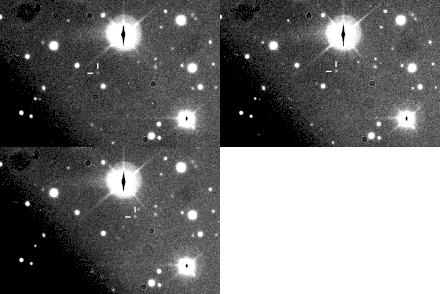
 Discovery images of Euporie by the Canada-France-Hawaii Telescope in December 2001 | |
| Discovery[1] | |
|---|---|
| Discovered by | Scott S. Sheppard et al. |
| Discovery site | Mauna Kea Obs. |
| Discovery date | 11 December 2001 |
| Designations | |
Designation | Jupiter XXXIV |
| Pronunciation | /ˈjuːpəriː/[2] |
Named after | Ευπορία Eyporia |
| S/2001 J 10 | |
| Adjectives | Euporian /juːˈpɔːriən/[3] |
| Orbital characteristics [4] | |
| 19302000 km | |
| Eccentricity | 0.144 |
| −550.7 days | |
| 293.0° | |
| Inclination | 145.8° |
| 64.9° | |
| 74.6° | |
| Satellite of | Jupiter |
| Group | Ananke group |
| Physical characteristics | |
Mean diameter | 2 km |
| 23.1 | |
Euporie /ˈjuːpəriː/, also known as Jupiter XXXIV, is a natural satellite of Jupiter. It was discovered by a team of astronomers from the University of Hawaii led by Scott S. Sheppard in 2001, and given the temporary designation S/2001 J 10.[5][1]
Euporie is about 2 kilometres in diameter, and orbits Jupiter at an average distance of 19,088 Mm in 538.780 days, at an inclination of 145° to the ecliptic (145° to Jupiter's equator), in a retrograde direction and with an eccentricity of 0.144.
It was named in August 2003 after Euporie, a Greek goddess of abundance and one of the Horae in Greek mythology (and thus a daughter of Zeus).[6] It is a member of the Ananke group.
References
- 1 2 Brian G. Marsden (15 May 2002). "MPEC 2002-J54: Eleven New Satellites of Jupiter". International Astronomical Union Minor Planet Center.
- ↑ per "eupory". Oxford English Dictionary (Online ed.). Oxford University Press. (Subscription or participating institution membership required.)
- ↑ per "euporia". Oxford English Dictionary (Online ed.). Oxford University Press. (Subscription or participating institution membership required.)
- ↑ S.S. Sheppard (2019), Moons of Jupiter, Carnegie Science, on line
- ↑ Daniel W. E. Green (16 May 2002). "IAUC 7900: Satellites of Jupiter". International Astronomical Union.
- ↑ Daniel W. E. Green (9 August 2002). "IAUC 8177: Satellites of Jupiter, Saturn, Uranus". International Astronomical Union. Archived from the original on 27 March 2012.
Listed in increasing approximate distance from Jupiter | |
| Inner moons (4) | |
| Galilean moons (4) | |
| Themisto group (1) | |
| Himalia group (9) | |
| Carpo group (2) | |
| Valetudo group (1) | |
| Ananke group (26) | |
| Carme group (30) | |
| Pasiphae group (18) | |
| See also | |
| |

This article is issued from Wikipedia. The text is licensed under Creative Commons - Attribution - Sharealike. Additional terms may apply for the media files.