Hizen-Kubo Station 肥前久保駅 | |
|---|---|
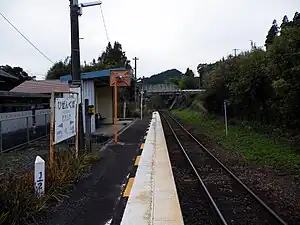 Platform of Hizen-Kubo Station in 2008 | |
| General information | |
| Location | Japan |
| Coordinates | 33°21′21″N 130°00′02″E / 33.35583°N 130.00056°E |
| Operated by | .svg.png.webp) JR Kyushu JR Kyushu |
| Line(s) | ■ Chikuhi Line |
| Distance | 5.1 km from Yamamoto |
| Platforms | 1 side |
| Tracks | 1 |
| Construction | |
| Structure type | At grade |
| Bicycle facilities | Bike shed |
| Other information | |
| Status | Unstaffed |
| Website | Official website |
| History | |
| Opened | 1 March 1935 |
| Previous names | Banzoīn (until 1 October 1937) |
| Passengers | |
| FY2015 | 14 daily |
| Location | |
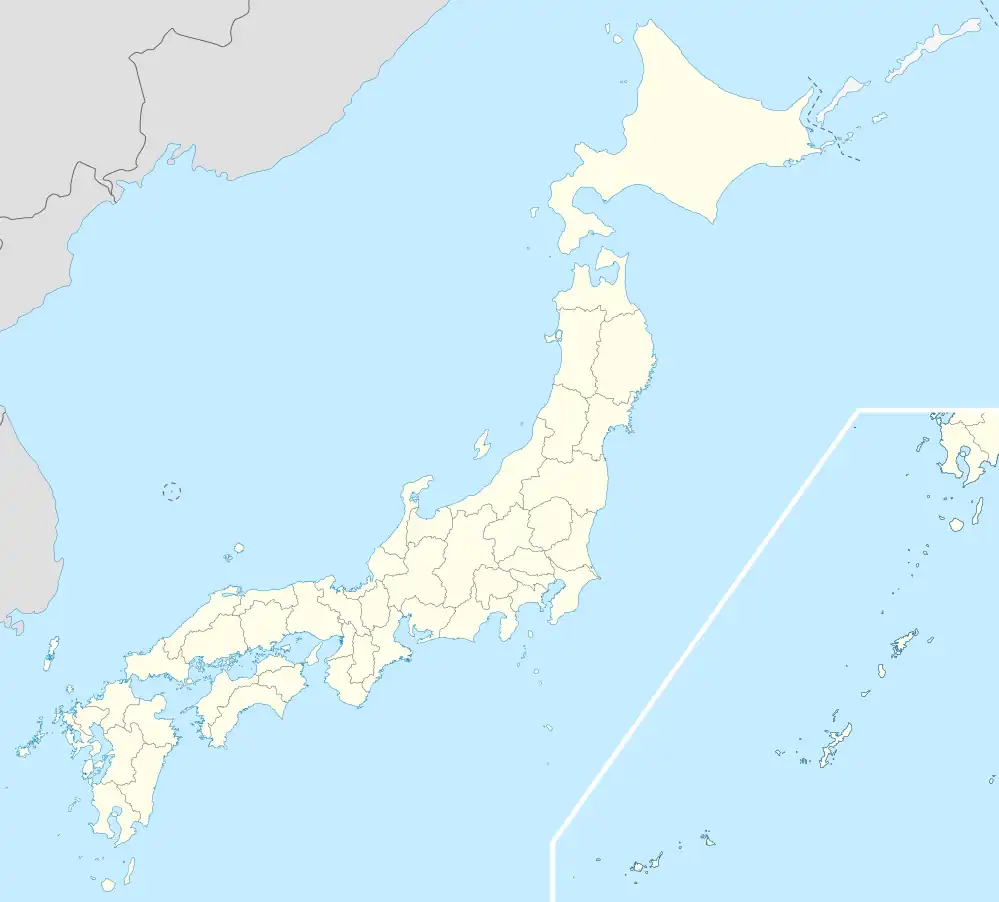  Hizen-Kubo Station Location within Japan | |
Hizen-Kubo Station (肥前久保駅, Hizen-Kubo-eki) is a railway station on the Chikuhi Line of Kyushu Railway Company (JR Kyushu), located in Karatsu, Saga Prefecture, Japan.[1][2]
Lines
The station is served by the western section of the Chikuhi Line and is 5.1 km from the starting point of this section at Yamamoto.[3]
Station layout
The station, which is unstaffed, consists of a side platform serving a single track at grade. There is no station building but a shelter is provided on the platform. In addition, a waiting room named "Sakura-kan" (meaning Cherry Blossom Room) has been set up near the station entrance. A bike shed is provided nearby.[2][3]
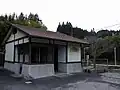 The waiting room "Sakura-kan".
Adjacent stations
| ← | Service | → | ||
|---|---|---|---|---|
| Chikuhi Line (western section) | ||||
| Yamamoto | Local | Nishi-Ōchi | ||
History
The private Kitakyushu Railway, which had a track between Hakata and Higashi-Karatsu by 1926 and had expanded southwards to Yamamoto by 1929. In a later phase of expansion, the track was extended west from Yamamoto to Imari, which opened as the western terminus on 1 March 1935. This station was opened on the same day as an intermediate station on the new track under the name Banzuīn (幡随院). The Kitakyushi Railway was nationalised on 1 October 1937 and Japanese Government Railways (JGR) assumed control of the station, renamed it Hizen-Kubo and designated the track which served it as part of the Chikuhi Line. With the privatization of Japanese National Railways (JNR), the successor of JGR, on 1 April 1987, control of the station passed to JR Kyushu.[4] [5]
Passenger statistics
In fiscal 2015, there were a total of 5,125 boarding passengers, giving a daily average of 14 passengers.[6]
Environs
References
- ↑ "JR Kyushu Route Map" (PDF). JR Kyushu. Retrieved 3 March 2018.
- 1 2 "肥前久保" [Hizen-Kubo]. hacchi-no-he.net. Retrieved 31 March 2018.
- 1 2 Kawashima, Ryōzō (2013). 図説: 日本の鉄道 四国・九州ライン 全線・全駅・全配線・第5巻 長崎 佐賀 エリア [Japan Railways Illustrated. Shikoku and Kyushu. All lines, all stations, all track layouts. Volume 5 Nagasaki Saga area] (in Japanese). Kodansha. pp. 14, 82. ISBN 9784062951647.
- ↑ Ishino, Tetsu; et al., eds. (1998). 停車場変遷大事典 国鉄・JR編 [Station Transition Directory – JNR/JR] (in Japanese). Vol. I. Tokyo: JTB Corporation. pp. 224–5. ISBN 4-533-02980-9.
- ↑ Ishino, Tetsu; et al., eds. (1998). 停車場変遷大事典 国鉄・JR編 [Station Transition Directory – JNR/JR] (in Japanese). Vol. II. Tokyo: JTB Corporation. p. 726. ISBN 4-533-02980-9.
- ↑ "佐賀県統計年鑑(平成28年版)" [Saga Prefecture Statistics Yearbook 2016 Edition]. Saga Prefectural Government website. Retrieved 23 March 2018. See table 12-7 at section under Transportation and Communications.

External links
- Hizen-Kubo Station (JR Kyushu)(in Japanese)