Mary Riddle | |
|---|---|
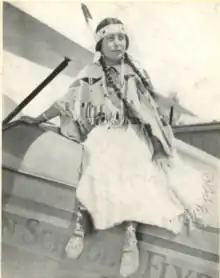 Mary Riddle posing with her plane. | |
| Born | April 22, 1902 |
| Died | October 25, 1981 (aged 79) |
| Nationality | Quinault, American |
| Other names | Kus-de-cha |
| Known for | First Native American woman airplane pilot |
Mary Riddle, also known as Kus-de-cha or Kingfisher,[1] (April 22, 1902 – October 25, 1981) was the first Native American woman to earn a pilot's license[2][3] Soon after earning her pilot's license she also earned her commercial license.[4]
Early life
Riddle was a member of the Clatsop Tribe in Oregon[2] and the Quinault Indian Nation in Washington.[5] She was born on April 22, 1902 in Bruceport, Washington to parents Albert "Doc" Riddell and Elizabeth Salikike.[6] Elizabeth Salikike's family name was also spelled as Salikie and Silackie in various sources.[7]
Riddle said that her grandmother gave her the name Kus-de-cha, meaning 'kingfisher', after noting that her cries sounded like a kingfisher's call.[8] Anthropologist Llyn de Danaan states that the word 'kus-de-cha' does not appear in the Chinook, Clatsop, or Lower Chehalis languages.[9] However, 'kuśdecá' is listed as the Dakota word for kingfisher in the book An English and Dakota Vocabulary.[10]
Riddle had two brothers, Thomas and Valentine.[6] After their mother's death in 1905, Riddle and her brothers were placed in the Chemawa Indian School in Salem, Oregon.[6] In 1911, Riddle was transferred to the Sisters of the Valley Academy in Beaverton, Oregon. Riddle's father died in 1912.[6]
Riddle's interest in aviation began when she first saw an airplane while on a trip home from the Sisters of the Valley Academy.[11] When Riddle was seventeen, she saw a woman fatally crash an airplane.[12] The incident made her determined to prove women could fly well.[12]
Aviation career
Pilot
Riddle saved money for two years[13] to attend the Rankin Flying School in Portland, run by noted aviator Tex Rankin.[14] Rankin, who also taught Chinese-American pilot Leah Hing, was interested in creating "a 'rainbow', all-female stunt team," but Riddle declined to participate, and the idea fizzled out.[15] She flew solo for the first time on May 10, 1930.[13] "I wasn't scared," said Riddle one month later. "On that first trip alone I just missed the weight of the instructor in the plane."[13] She featured in an airshow at the 1930 Portland Rose Festival, riding up to her plane on horseback and in "full tribal costume".[16] Riddle was one of three female pilots in the show: the others were Dorothy Hester and Edith Foltz.[17] In August of that year, she made plans to fly to Washington, D.C., with "beaded gifts from Indian tribes of the Northwest", to be delivered to for "President Hoover and others".[18] Riddle earned a limited commercial pilot's license in 1933.[19] In June 1934, she was featured on the 99's magazine, The 99er.[20] An all-around athlete, she enjoyed swimming, riding, "golf, tennis, and ice skating."[21]
Parachutist
Riddle later went to the Spartan School in Tulsa to learn parachute jumping.[22] Though the school was all-male at the time, Riddle convinced them to admit her and graduated with honors.[22] By 1937 she was performing as a parachutist[23] while touring the United States on The Voice of Washington, advertised as the largest tri-motored plane in the world,[24] on which she also served as chief stewardess.[1] Press described her as quiet and charming.[21] Riddle did forty parachute jumps.[14] In 1937, she almost died when her parachute, which had not opened correctly, became tangled with her legs.[24] The next year, a back injury caused her to quit parachuting.[8]
Aircraft Inspector
World War II restrictions on civilian aircraft forced Riddle to give up flying.[8] She began working with aluminum sheet metal as part of the U.S. Air Force's Civil Service, reasoning, "I just had to be near airplanes- even if I could not fly them."[8] She was recruited by the government to inspect civilian aircraft and work as an aircraft maintenance advisor.[14] Riddle recalled, "I was a sort of guinea pig, really, on account of being the only woman, but I got along fine."[25]
Later life
After the war, Riddle became a receptionist at the Gibbs and Hill firm in New York City, but continued to fly on occasion and to visit the Northwest.[25]
See also
References
- 1 2 "To Dare Death Here". The Bismarck Tribune. 20 May 1937. Retrieved 31 August 2016 – via Newspapers.com.
- 1 2 "Mary Riddle, First Native American Woman Aviator". One of Many Feathers. Archived from the original on 2 February 2017. Retrieved 31 August 2016.
- ↑ "Future Beauty Queen: Wins French Crown: To-morrow's Citizen". The Ottawa Journal. 10 June 1930. Retrieved 31 August 2016 – via Newspapers.com.
- ↑ "Mary Riddle, First Native American Woman Aviator". www.oneofmanyfeathers.com. Archived from the original on 2017-02-02. Retrieved 2017-03-04.
- ↑ "Indian Girl is Full-Fledged Flyer". Rock Valley Bee. 11 July 1930. Retrieved 31 August 2016 – via Newspapers.com.
- 1 2 3 4 de Danaan, Llyn (Summer 2019). "Filling the Sky With Thunderbirds". Montana The Magazine of Western History. 69 (2): 53. Retrieved 3 December 2023.
- ↑ "Joseph George". Chinook Story. Retrieved 3 December 2023.
- 1 2 3 4 "Stunt Flier Quits Thrills To Serve US". Jefferson City Post-Tribune. 25 May 1943. Retrieved 29 December 2018 – via Newspapers.com.
- ↑ de Danaan, Llyn (2019). "Filling the Sky With Thunderbirds". Montana The Magazine of Western History. 69 (2): 92. Retrieved 3 December 2023.
- ↑ Riggs, Mary Ann Clark (1852). An English and Dakota Vocabulary. New York: R. Craighead. p. 60.
- ↑ Rummel, Dick (5 June 1930). "Indian Girl Has Yearn For Sky, Becomes Pilot". Oregon Daily Journal.
- 1 2 Bulman, Morgan (22 November 2017). "Native American Women Aviation Pioneers". Smithsonian Air and Space Museum. Retrieved 29 December 2018.
- 1 2 3 Rummel, Dick (5 June 1930). "Indian Girl Has Yearn For Sky; Becomes Pilot". The Oregon Daily Journal.
- 1 2 3 Speirs, Jim (28 May 2010). "Tex Rankin's Flying School, and the Golden Age of Women aviators" (PDF). St. Johns Review. 107 (11): 1. Retrieved 31 August 2016.
- ↑ Boule, Margie (29 July 2001). "If The Hereafter Has Rules, Leah Hing's Breaking Them". The Oregonian.
- ↑ "Crowds Acclaim Floral Parade". The Klamath News. 14 June 1930. Retrieved 30 December 2018 – via Newspapers.com.
- ↑ "Aviator Thrills Crowd". The Oregonian. 14 June 1930. p. 12.
- ↑ "Indian Girl Pilot To Fly East". Daily News. 3 August 1930. p. 3. Retrieved 30 December 2018 – via Newspapers.com.
- ↑ "Indian Girl Wins Flyers License". The Los Angeles Times. 19 September 1933. p. 6. Retrieved 29 December 2018 – via Newspapers.com.
- ↑ French, Jack (2011). "Lady Aviators: In History and Popular Fiction from the 1700s to World War II". Winged Victory. Retrieved 31 August 2016.
- 1 2 "A.W. Lucas Co. Sponsoring Spectacular Parachute Jump". The Bismarck Tribune. 21 May 1937. p. 5. Retrieved 30 December 2018 – via Newspapers.com.
- 1 2 "A. W. Lucas Co. Sponsoring Spectacular Parachute Jump by Princess Kus-de-cha". The Bismarck Tribune. 21 May 1937. Retrieved 31 August 2016 – via Newspapers.com.
- ↑ "A look back..." The Daily News. 28 April 1977. Retrieved 31 August 2016 – via newspapers.com.
- 1 2 "Air Circus Here". St. Cloud Times. 5 June 1937. Retrieved 4 November 2018 – via Newspapers.com.
- 1 2 Rothert, Yvonne (6 February 1975). "Pilot Called First Licensed Indian Woman". The Oregonian.