| Monodora stenopetala | |
|---|---|
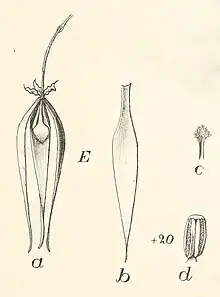 | |
| Botanical illustration of a Monodora stenopetala flower and floral parts.[1] | |
Scientific classification  | |
| Kingdom: | Plantae |
| Clade: | Tracheophytes |
| Clade: | Angiosperms |
| Clade: | Magnoliids |
| Order: | Magnoliales |
| Family: | Annonaceae |
| Genus: | Monodora |
| Species: | M. stenopetala |
| Binomial name | |
| Monodora stenopetala | |

Monodora stenopetala is a species of plant in the family Annonaceae. It is native to Malawi and Mozambique.[3] Daniel Oliver, the English botanist who first formally described the species, named it after its narrow (Latinized form of Greek στενος, stenos)[4] petals.
Description
It is a bush or small tree. Its leaves are 8.5-11 by 3-4.2 centimeters and rounded at their tips. The leaves are lightly hairy on their upper and lower surfaces. Its petioles are 3-4 millimeters long. Its solitary flowers are extra-axillary. Each flower is on a pedicel 1-1.6 centimeters long. Its flowers have 3 oblong sepals that are 4-5 millimeters long. The sepals are smooth, curved backwards, and have wavy or fringed margins. Its 6 petals are arranged in two rows of 3. The outer petals are yellow, 3.5-5 by 0.2-0.4 centimeters, and smooth or lightly hairy. The inner petals are similarly colored. The inner petals have a 0.3-0.7 centimeter long claw at their base and a 0.2-0.4 by 0.35-0.5 centimeter blade. The inner petals are smooth on their outer surface, and hairy inside. Its stamens that are 0.35 millimeters long. Its fruit are 6 by 4 centimeters smooth ellipsoids. Its smooth yellow-brown seeds are 1.5-2 centimeters long.[5][6]
Reproductive biology
The pollen of M. stenopetala is shed as permanent tetrads.[7]
Habitat and distribution
It has been observed growing in dense thickets and woodslands at elevations from 100-500 meters.[8]
Uses
It has been reported to be used in Mozambique as a traditional medicine.[9]
References
- ↑ Diels, Ludwig; Engler, Adolf; Gilg, Ernst; Schumann, K. (1901). Monographieen afrikanischer Pflanzen-Familien und -Gattungen [Monographs of African Plant Families and Genera] (in German and Latin). Leipzig: W. Engelmann.
- ↑ Cosiaux, A.; Couvreur, T.L.P.; Erkens, R.H.J. (2019). "Monodora stenopetala". IUCN Red List of Threatened Species. 2019: e.T132683658A133046265. doi:10.2305/IUCN.UK.2019-3.RLTS.T132683658A133046265.en. Retrieved 20 November 2021.
- ↑ "Monodora stenopetala Oliv". Plants of the World Online. The Trustees of the Royal Botanic Gardens, Kew. n.d. Retrieved April 26, 2019.
- ↑ Stearn, William (2004). Botanical Latin. Portland, Ore. Newton Abbot: Timber Press David & Charles. ISBN 9780881926279.
- ↑ Oliver, Daniel (1868). Flora of Tropical Africa. London: L. Reeve and Co. p. 39.
- ↑ Robson, N.K.B. (1960). "Annonaceae". In Exell, A.W.; Wild, H. (eds.). Flora Zambesiaca. London: Royal Botanic Gardens, Kew.
- ↑ Couvreur, Thomas L. P.; Botermans, Marleen; van Heuven, Bertie Joan; van der Ham, Raymond W. J. M. (2008). "Pollen morphology within the Monodora clade, a diverse group of five African Annonaceae genera". Grana. 47 (3): 185–210. doi:10.1080/00173130802256913. ISSN 0017-3134.
- ↑ Couvreur, Thomas L. P. (2009). "Monograph of the Syncarpous African Genera Isolona and Monodora (Annonaceae)". Systematic Botany Monographs. 87: 1–150.
- ↑ Sitoe, Eunezia (2020). Medicinal Ethnobotany of Mozambique: A Review and Analysis (MSc). University of Johannesburg. Retrieved June 11, 2021.