| NCSIST Chien Hsiang | |
|---|---|
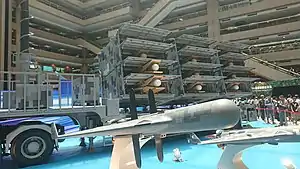 Launcher of Chien hsiang loitering munition | |
| Type | Loitering munition |
| Place of origin | Taiwan |
| Service history | |
| Used by | Republic of China Air Force |
| Production history | |
| Manufacturer | National Chung-Shan Institute of Science and Technology |
| Specifications | |
| Length | 1,200 mm (47 in) |
| Width | 2,000 mm (79 in) |
| Wingspan | 2,000 mm (79 in) |
| Propellant | Liquid fuel |
| Maximum speed | 185 km/h (115 mph) |
Guidance system | EO, inertial, and anti-radiation homing |
Launch platform | Box launcher |
| Transport | Tractor trailer |
The NCSIST Chien Hsiang (Taiwanese: kiàm-siông; English "Rising Sword”) is a Taiwanese anti-radiation loitering munition developed by the National Chung-Shan Institute of Science and Technology.
Overview
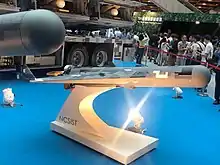
The Chien Hsiang is two meters wide, and 1.2 meters long.[1] It has a delta wing and a pusher propeller.[2] The Chien Hsiang has a reported loiter time of 100 hours and a top speed of 185 km/h.[3] They are primarily intended to fill the anti-radiation weapon role targeting enemy radars, transmitters, and associated systems.[2]
While the Chien Hsiang is comparable to the Israeli IAI Harpy, NCSIST has said that any resemblance is purely coincidental and that the platform is entirely indigenous.[4]
A variant with a sensor ball mounted under its nose has been displayed.[2]
History
The Chien Hsiang was first exhibited in 2017 at the Taipei Aerospace & Defense Technology Exhibition.[5] In 2019 the Taiwan Air Force’s Air Defense and Missile Command announced a five year, NT$80b (US$2.54b) project to build up a full force of anti-radiation UAVs.[6]
In 2022, it was reported that Chien Hsiang production was ahead of schedule and initial procurement was expected to be completed by 2024 or 2025.[7]
Launcher
The main Chien Hsiang launch platform is a trailer mounting twelve box launchers.[1] It can also be launched from fixed positions and naval vessels.[8]
Variants
Decoy
Designed to confuse air defenses systems in conjunction with strike Chien Hsiangs.[9]
Anti-ship
Two Chien Hsiang derivatives with larger warheads were displayed in 2023.[9]
See also
References
- 1 2 Everington, Keoni (21 October 2019). "Taiwan building fleet of Kamikaze drones to counter attack by China". www.taiwannews.com.tw. Taiwan News. Retrieved 21 October 2019.
- 1 2 3 TREVITHICK, JOSEPH (18 August 2023). "Rare Look At Taiwan's Chien Hsiang Kamikaze Drone In Action". thedrive.com. The Drive. Retrieved 27 August 2023.
- ↑ Cole, J. Michael (17 August 2017). "Taiwanese Military Unveils New Equipment at Defense Trade Show". Taiwan Sentinel. Retrieved 22 October 2019.
- ↑ Wong, Kelvin. "TADTE 2019: Taiwan's NCSIST rolls out indigenous anti-radiation loitering munition". www.janes.com. Janes. Retrieved 21 October 2019.
- ↑ Cole, J. Michael (30 June 2019). "How Taiwan Can Defend Its Coastline Against China". National Interest. Retrieved 22 October 2019.
- ↑ Liao, George (19 June 2019). "Taiwan military to spend NT$80 billion on anti-radiation drone fleet". Taiwan News. Retrieved 22 October 2019.
- ↑ Tien-pin, Lo; Chin, Jonathan (4 March 2022). "MND details missile program schedule". taipeitimes.com. Taipei Times. Retrieved 21 April 2022.
- ↑ HELFRICH, EMMA; ROGOWAY, TYLER (16 November 2022). "Taiwan Shows Off Its Radar-Killing Kamikaze Drones". thedrive.com. The Drive. Retrieved 18 November 2022.
- 1 2 DOMINGUEZ, GABRIEL (14 March 2023). "Taking page from Ukraine, Taiwan shows off new killer drones". japantimes.co.jp/. Japan Times. Retrieved 14 March 2023.