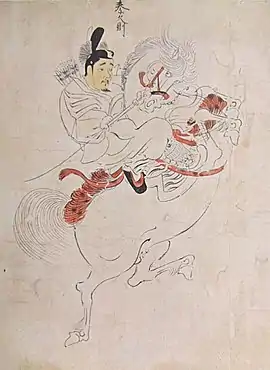
Nise-e (似絵), or "likeness pictures," were a style of portraiture popular in the court circles of Japan's Kamakura period.[1] Prior to the 12th century Japanese art was purely religious in character, but nise-e introduced the realistic depiction of lay figures such as courtiers and samurai.[1][2] The popularity of nise-e even helped to end the taboo against artistic depictions of the emperor, with one of earliest nise-e to depict a living emperor being a portrait of Emperor Hanazono by Gōshin.[3] The aim of a nise-e portrait was to capture a man's character with a few simple lines; and the work served as a veneration of his accomplishments.[1]

Fujiwara Takanobu is generally considered to have originated the nise-e style and technique.[4] He innovated the use of jutting, angular outlines and dense swaths of color which came to characterize nise-e portraiture as a whole.[5] Takanobu's influence is seen in the works of his son Fujiwara Nobuzane, and descendants Tametsugu, Korenobu, Tamenobu, and Gōshin, who continued to develop the nise-e school alongside others such as Shinkai and Tametaga.[6][1][7] Nise-e portraiture also greatly influenced the 18th century portrait style nigao-e (likeness head), pioneered by Katsukawa Shunshō in response to a desire for actor portraits with realistic and expressive facial features.[8]
References
- 1 2 3 4 "nise-e | Japanese art". Encyclopedia Britannica. Retrieved 2017-05-28.
- ↑ Steiner, Evgeny (2013). "Zen Portraits Chinzō: Why do They Look as They do?". Terebess Asia Online – via Google Scholar.
- ↑ Hirayama, Mikiko (2011). "The Emperor's New Clothes: Japanese Visuality and Imperial Portrait Photography". History of Photography. 33 (2): 165–184. doi:10.1080/03087290902768099.
- ↑ "Takanobu". Benezit Dictionary of Artists – via Oxford Art Online.
- ↑ "Fujiwara Takanobu | Japanese painter". Encyclopedia Britannica. Retrieved 2017-05-28.
- ↑ "Fujiwara Nobuzane | Japanese painter". Encyclopedia Britannica. Retrieved 2017-05-28.
- ↑ "Nobuzane". Benezit Dictionary of Artists – via Oxford Art Online.
- ↑ "Shunsho". Benezit Dictionary of Artists – via Oxford Art Online.
