In mathematics, the prime zeta function is an analogue of the Riemann zeta function, studied by Glaisher (1891). It is defined as the following infinite series, which converges for :


Properties
The Euler product for the Riemann zeta function ζ(s) implies that
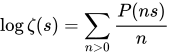
which by Möbius inversion gives
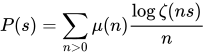
When s goes to 1, we have . This is used in the definition of Dirichlet density.
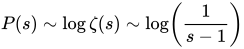
This gives the continuation of P(s) to , with an infinite number of logarithmic singularities at points s where ns is a pole (only ns = 1 when n is a squarefree number greater than or equal to 1), or zero of the Riemann zeta function ζ(.). The line is a natural boundary as the singularities cluster near all points of this line.


If one defines a sequence
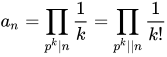
then
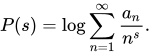
(Exponentiation shows that this is equivalent to Lemma 2.7 by Li.)
The prime zeta function is related to Artin's constant by
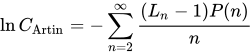
where Ln is the nth Lucas number.[1]
Specific values are:
| s | approximate value P(s) | OEIS |
|---|---|---|
| 1 | [2] | |
| 2 | OEIS: A085548 | |
| 3 | OEIS: A085541 | |
| 4 | OEIS: A085964 | |
| 5 | OEIS: A085965 | |
| 9 | OEIS: A085969 |






Analysis
Integral
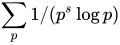
The integral over the prime zeta function is usually anchored at infinity, because the pole at prohibits defining a nice lower bound at some finite integer without entering a discussion on branch cuts in the complex plane:

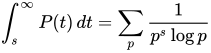
The noteworthy values are again those where the sums converge slowly:
| s | approximate value | OEIS |
|---|---|---|
| 1 | OEIS: A137245 | |
| 2 | OEIS: A221711 | |
| 3 | ||
| 4 |




Derivative
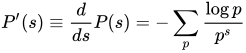
The first derivative is
The interesting values are again those where the sums converge slowly:
| s | approximate value | OEIS |
|---|---|---|
| 2 | OEIS: A136271 | |
| 3 | OEIS: A303493 | |
| 4 | OEIS: A303494 | |
| 5 | OEIS: A303495 |





Generalizations
Almost-prime zeta functions
As the Riemann zeta function is a sum of inverse powers over the integers and the prime zeta function a sum of inverse powers of the prime numbers, the k-primes (the integers which are a product of not necessarily distinct primes) define a sort of intermediate sums:


where is the total number of prime factors.

| k | s | approximate value | OEIS |
|---|---|---|---|
| 2 | 2 | OEIS: A117543 | |
| 2 | 3 | ||
| 3 | 2 | OEIS: A131653 | |
| 3 | 3 |





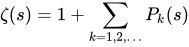
Each integer in the denominator of the Riemann zeta function may be classified by its value of the index , which decomposes the Riemann zeta function into an infinite sum of the :


Since we know that the Dirichlet series (in some formal parameter u) satisfies

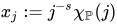
we can use formulas for the symmetric polynomial variants with a generating function of the right-hand-side type. Namely, we have the coefficient-wise identity that when the sequences correspond to where denotes the characteristic function of the primes. Using Newton's identities, we have a general formula for these sums given by
![{\displaystyle P_{k}(s)=[u^{k}]P_{\Omega }(u,s)=h(x_{1},x_{2},x_{3},\ldots )}](../I/146ebca30b393f6decd219293133837e137ed48f.svg)

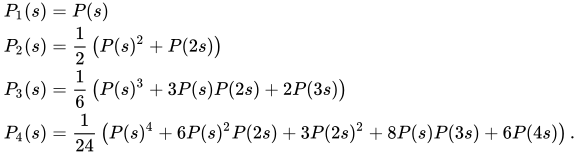
![{\displaystyle P_{n}(s)=\sum _{{k_{1}+2k_{2}+\cdots +nk_{n}=n} \atop {k_{1},\ldots ,k_{n}\geq 0}}\left[\prod _{i=1}^{n}{\frac {P(is)^{k_{i}}}{k_{i}!\cdot i^{k_{i}}}}\right]=-[z^{n}]\log \left(1-\sum _{j\geq 1}{\frac {P(js)z^{j}}{j}}\right).}](../I/a0ae44734b9408a6228db71ff237f10aefcd10f7.svg)
Special cases include the following explicit expansions:
Prime modulo zeta functions
Constructing the sum not over all primes but only over primes which are in the same modulo class introduces further types of infinite series that are a reduction of the Dirichlet L-function.
See also
References
- Merrifield, C. W. (1881). "The Sums of the Series of Reciprocals of the Prime Numbers and of Their Powers". Proceedings of the Royal Society. 33 (216–219): 4–10. doi:10.1098/rspl.1881.0063. JSTOR 113877.
- Fröberg, Carl-Erik (1968). "On the prime zeta function". Nordisk Tidskr. Informationsbehandling (BIT). 8 (3): 187–202. doi:10.1007/BF01933420. MR 0236123. S2CID 121500209.
- Glaisher, J. W. L. (1891). "On the Sums of Inverse Powers of the Prime Numbers". Quart. J. Math. 25: 347–362.
- Mathar, Richard J. (2008). "Twenty digits of some integrals of the prime zeta function". arXiv:0811.4739 [math.NT].
- Li, Ji (2008). "Prime graphs and exponential composition of species". Journal of Combinatorial Theory. Series A. 115 (8): 1374–1401. arXiv:0705.0038. doi:10.1016/j.jcta.2008.02.008. MR 2455584. S2CID 6234826.
- Mathar, Richard J. (2010). "Table of Dirichlet L-series and prime zeta modulo functions for small moduli". arXiv:1008.2547 [math.NT].