| Pseudoxandra polyphleba | |
|---|---|
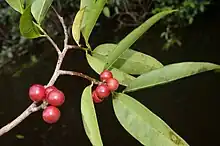 | |
| Photograph of Pseudoxandra polyphleba with fruit.[1] | |
Scientific classification  | |
| Kingdom: | Plantae |
| Clade: | Tracheophytes |
| Clade: | Angiosperms |
| Clade: | Magnoliids |
| Order: | Magnoliales |
| Family: | Annonaceae |
| Genus: | Pseudoxandra |
| Species: | P. polyphleba |
| Binomial name | |
| Pseudoxandra polyphleba | |
| Synonyms | |
|
Cremastosperma polyphlebum (Diels) R.E.Fr. | |
Pseudoxandra polyphleba is a species of plant in the family Annonaceae. It is native to Bolivia, Brazil, Colombia, French Guiana, Guyana, and Peru.[3] Ludwig Diels, the German botanist who first formally described the species using the basionym Unonopsis polyphleba, named it after the distinctive veins (Latinized form of Greek φλέβα, phléba)[4] in its leaves.[5]
Description
It is a tree reaching 4 to 15 meters in height. Its dull papery leaves are 10-19 by 3-6 centimeters and come to a point at their tips. The leaves are hairless on their upper and lower surfaces, but can have small warty bumps. The leaves have 10-15 distinct, straight secondary veins emanating from the primary vein. Its petioles are 2-7 millimeters long. Its flowers are solitary or in pairs and axillary. Each flower is on a pedicel 2-5 millimeters long. Its flowers have 3 oval-shaped sepals that are 1-2 by 2-3 millimeters. The outer surface of the sepals is hairless or slightly hairy. Its 6 petals are arranged in two rows of 3. The outer petals are white to yellow and 4-10 by 3-5 millimeters. The outer petals are hairless on their outer surface. The inner petals are similarly colored and 3-8 by 3-5 millimeters. The inner petals are smooth on their outer surface. It has numerous stamens that are 1.5-1.7 millimeters long. Each flower has 2-20 monocarps that are yellow, red, or near black at maturity and 10-15 millimeters wide. Its brown seeds are 8-13 by 7-12 millimeters.[6]
Reproductive biology
The pollen of P. polyphleba is shed as permanent tetrads.[7]
References
- ↑ "Pseudoxandra polyphleba (Diels) R.E. Fr". Tropicos. Tropicos.org. Missouri Botanical Garden. n.d. Retrieved August 23, 2023.
- ↑ Botanic Gardens Conservation International (BGCI).; IUCN SSC Global Tree Specialist Group (2019). "Pseudoxandra polyphleba". IUCN Red List of Threatened Species. 2019: e.T145665624A145665626. doi:10.2305/IUCN.UK.2019-2.RLTS.T145665624A145665626.en. Retrieved 20 November 2021.
- ↑ "Pseudoxandra polyphleba (Diels) R.E.Fr". Plants of the World Online. The Trustees of the Royal Botanic Gardens, Kew. n.d. Retrieved May 23, 2019.
- ↑ Stearn, William (2004). Botanical Latin. Portland, Ore. Newton Abbot: Timber Press David & Charles. ISBN 9780881926279.
- ↑ Pilger, R. (1905). "Beiträge zur Flora der Hylaea nach den Sammlungen von E. Ule. Unter Mitwirkung namhafter Fachgenossen herausgegeben" [Contributions to the flora of the Hylaea after the collections of E. Ule. Issued with the participation of well-known experts]. Verhandlungen des Botanischen Vereins für die Provinz Brandenburg (in German and Latin). 47: 100–191.
- ↑ Maas, Paul J.M.; Westra, Lubbert Y.Th. (2003). "Revision of the Neotropical genus Pseudoxandra (Annonaceae)". Blumea - Biodiversity, Evolution and Biogeography of Plants. 48 (2): 201–259. doi:10.3767/000651903X674955. ISSN 0006-5196.
- ↑ Walker, James W. (1971). "Pollen Morphology, Phytogeography, and Phylogeny of the Annonaceae". Contributions from the Gray Herbarium of Harvard University. 202 (202): 1–130. doi:10.5962/p.272704. JSTOR 41764703. S2CID 249081277.