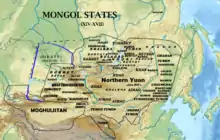
This is a timeline of the Northern Yuan dynasty.
14th century
| Year | Date | Event |
|---|---|---|
| 1368 | The Yuan dynasty retreats to Karakorum[1] | |
| 1380 | Ming dynasty sacks Karakorum[1] | |
| 1381 | December | Ming conquest of Yunnan: Ming forces take Qujing[2] |
| 1382 | April | Ming conquest of Yunnan: Ming forces conquer Yunnan[3] |
| 1387 | October | Ming campaign against the Uriankhai: Naghachu surrenders to Ming forces[4] |
| 1388 | May | Battle of Buir Lake: Ming forces defeat Uskhal Khan Tögüs Temür[5] |
| November | Jorightu Khan Yesüder defeats Uskhal Khan and became the Khagan of Forty-four tumun Mongols[6] | |
| 1399 | The Four Oirats break away from Mongol Khagan[7] |
15th century
| Year | Date | Event |
|---|---|---|
| 1408 | Öljei Temür Khan defeats Örüg Temür Khan and becomes ruler of Mongols[7] | |
| 1409 | 23 September | Battle of Kherlen: Ming forces are defeated by Öljei Temür Khan[8] |
| 1410 | 15 June | First Mongol Campaign: The Yongle Emperor defeats Öljei Temür Khan on the banks of the Onon River[8] |
| July | First Mongol Campaign: Ming forces defeat Arughtai east of the Greater Khingan and withdraw to Nanjing[8] | |
| 1414 | April | Second Mongol Campaign: Ming forces engage Oirats at the Tuul River, suffering heavy casualties, but ultimately prevail through the use of heavy cannon bombardments[9] |
| 1422 | April | Third Mongol Campaign: Ming forces are dispatched against Arughtai but fail to engage him in combat and return to Beijing[9] |
| 1423 | August | Fourth Mongol Campaign: The Yongle Emperor launches an offensive against Arughtai only to find out he had already been defeated by the Oirats[10] |
| 1424 | April | Fifth Mongol Campaign: The Yongle Emperor leads an expedition against the remnants of Arughtai's horde but fails to find them[10] |
| 1428 | October | Uriankhai raid Ming borders and the Xuande Emperor personally leads troops to repel them[11] |
| 1433 | The Oirats install Taisun Khan as leader of the Eastern Mongols[7] | |
| 1449 | July | Tumu Crisis: Esen Taishi of the Oirats and de facto ruler of the Northern Yuan launches an invasion of the Ming dynasty[12] |
| 4 August | Tumu Crisis: The Zhengtong Emperor departs from Beijing to personally confront Esen Taishi[13] | |
| 30 August | Tumu Crisis: The Ming rearguard is defeated[14] | |
| 1 September | Tumu Crisis: The Ming army is annihilated and the Zhengtong Emperor is captured by Esen Taishi[15] | |
| 27 October | Esen Taishi lays siege to Beijing but fails to take it and withdraws after 5 days[16] | |
| 1451 | Esen Taishi declares himself Yuan Emperor, which causes widespread dissent among his followers[7] | |
| 1454 | Esen Taishi is killed and the Northern Yuan is once more split into two portions between the Oirats and Eastern Mongols[17] | |
| 1479 | Dayan Khan becomes ruler of Northern Yuan[17] | |
| 1483 | Dayan Khan defeats Ismayil Taishi[17] |
16th century
| Year | Date | Event |
|---|---|---|
| 1504 | Datong is raided by Mongols[18] | |
| 1510 | Dayan Khan conquers the Ordos Loop[19] | |
| 1517 | 16 October | Dayan Khan raids the Ming dynasty[20] |
| 20 October | The Zhengde Emperor repels Dayan Khan's raiding party[21] | |
| 1531 | Datong comes under raid by Mongols[22] | |
| 1536 | Mongols raid Shanxi but are repelled[23] | |
| 1537 | Mongols raid Datong[23] | |
| 1541 | October | Altan Khan raids Shaanxi[24] |
| 1542 | July | Altan Khan raids Shaanxi[24] |
| 4 August | Ming forces are defeated by Altan Khan at Guangwu[24] | |
| 8 August | Altan Khan pillages the suburbs of Taiyuan[24] | |
| 1548 | June | Mongols defeat Ming forces at Xuanfu[25] |
| October | Mongols raid Huailai[25] | |
| 1549 | March | Altan Khan defeats Ming forces at Xuanfu but suffers heavy casualties[25] |
| 1550 | 1 October | Altan Khan pillages the suburbs of Beijing[25] |
| 6 October | Ming forces are defeated by Mongols[26] | |
| 1552 | April | Ming forces are defeated by Mongols north of Datong[27] |
| 1557 | Daraisung Guden Khan is succeeded by his son, Tümen Zasagt Khan[28] | |
| winter | Sengge, son of Altan Khan, lays siege to a garrison near Datong[29] | |
| 1566 | Altan Khan captures some lamas in a raid[30] | |
| 1576 | Buddhism becomes the state religion of Northern Yuan[31] | |
| 1577 | Altan Khan names Sonam Gyatso the Dalai Lama, the first living person to take the title[31] | |
| 1590 | The Uriankhai and Yunshebu Tümen disperse, breaking into smaller units called ulus (nations)[32] | |
| 1598 | Mongols kill Li Rusong, the Ming commander-in-chief[33] |
17th century
| Year | Date | Event |
|---|---|---|
| 1619 | Chahar-Jurchen War: Ligdan Khan attacks Guangning, a horse trading town under the protection of Nurhaci, but is defeated[34] | |
| 1625 | Chahar-Jurchen War: Ligdan Khan's attack is turned back by a combined Khorchin Jurchen force[35] | |
| 1634 | Chahar-Jurchen War: Ligdan Khan is overthrown and displaced by Hong Taiji[36] | |
| 1636 | Mongols south of the Gobi Desert submit to the Qing dynasty[37] | |
| 1691 | The Khalkha Mongols submit to the Qing dynasty after being invaded by the Dzungar Khanate[38] | |
| 1696 | Dzungar–Qing Wars: The Qing dynasty takes all of Mongolia from the Dzungar Khanate[38] |
References
- 1 2 Adle 2003, p. 209.
- ↑ Twitchett 1998, p. 144.
- ↑ Mote 2003, p. 557.
- ↑ Twitchett 1998, p. 158.
- ↑ Twitchett 1998, p. 159.
- ↑ Okada, Hidehiro (1994). "Dayan Khan as a Yüan Emperor: The Political Legitimacy in 15th Century Mongolia". Bulletin de l'École Française d'Extrême-Orient. 81: 51–58. doi:10.3406/befeo.1994.2245. JSTOR 43731760.
- 1 2 3 4 Adle 2003, p. 210.
- 1 2 3 Twitchett 1998, p. 226.
- 1 2 Twitchett 1998, p. 227.
- 1 2 Twitchett 1998, p. 228.
- ↑ Twitchett 1998, p. 299.
- ↑ Twitchett 1998, p. 322.
- ↑ Twitchett 1998, p. 323.
- ↑ Twitchett 1998, p. 324.
- ↑ Twitchett 1998, p. 325.
- ↑ Twitchett 1998, p. 328.
- 1 2 3 Adle 2003, p. 211.
- ↑ Twitchett 1998, p. 371.
- ↑ Twitchett 1998, p. 467.
- ↑ Twitchett 1998, p. 420.
- ↑ Twitchett 1998, p. 421.
- ↑ Twitchett 1998, p. 468.
- 1 2 Twitchett 1998, p. 472.
- 1 2 3 4 Twitchett 1998, p. 473.
- 1 2 3 4 Twitchett 1998, p. 475.
- ↑ Twitchett 1998, p. 476.
- ↑ Twitchett 1998, p. 477.
- ↑ Narangoa 2014, p. 17.
- ↑ Twitchett 1998, p. 478.
- ↑ Adle 2003, p. 213.
- 1 2 Adle 2003, p. 214.
- ↑ Narangoa 2014, p. 16.
- ↑ Twitchett 1998, p. 557.
- ↑ Narangoa 2014, p. 30.
- ↑ Narangoa 2014, p. 34.
- ↑ Crossley 1997, p. 77.
- ↑ Adle 2003, p. 146.
- 1 2 Adle 2003, p. 219.
Bibliography
- Adle, Chahryar (2003), History of Civilizations of Central Asia 5, UNESCO Publishing
- Crossley, Pamela Kyle (1997), The Manchus, Blackwell Publishers Ltd
- Mote, F. W. (2003), Imperial China: 900–1800, Harvard University Press, ISBN 978-0674012127
- Narangoa, Li (2014), Historical Atlas of Northeast Asia, 1590-2010: Korea, Manchuria, Mongolia, Eastern Siberia, New York: Columbia University Press, ISBN 9780231160704
- Twitchett, Denis (1998), The Cambridge History of China Volume 7 The Ming Dynasty, 1368—1644, Part I, Cambridge University Press
This article is issued from Wikipedia. The text is licensed under Creative Commons - Attribution - Sharealike. Additional terms may apply for the media files.