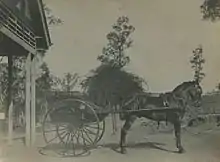
Pony trap in Brisbane, Australia, 1900.
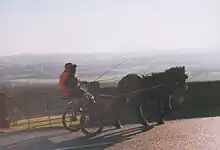
Pony and trap in northern England.
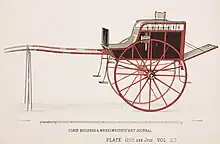
Trap_or_cart,_c_1903
A trap, pony trap (sometimes pony and trap) or horse trap is a light, often sporty, two-wheeled or sometimes four-wheeled horse- or pony-drawn carriage, usually accommodating two to four persons in various seating arrangements, such as face-to-face or back-to-back.[1][2][3][4] In the eighteenth century, the first carriage to be called a trap was a gig with a hinged trap door, under which was a place to carry a dog.[5][6] In late nineteenth century USA, four-wheeled dog carts with convertible seats also started to become known as traps.[7]
"Pony and trap" is also used as Cockney rhyming slang for "crap" meaning nonsense or rubbish, or defecation.[8]
See also
References
- ↑ "Hunting Trap". Carriage Association of America. Retrieved June 20, 2023.
- ↑ "Glossary of Carriages". The Kinross Carriageworks, Stirling 1802-1966. Retrieved June 20, 2023.
- ↑ Stanek, Anna (June 1, 2022). "12 Common Types of Horse Drawn Carriages". Horsey Hooves. Retrieved June 20, 2023.
- ↑ "Evolution of the Trap". Carriage Museum of America. Retrieved June 20, 2023.
- ↑ Tom Ryder (1979). "What is a trap?". The Carriage Journal. Carriage Association of America. 17 (1): 33–38.
- ↑ Jill Ryder, ed. (1996). "Name that carriage: The Trap". The Carriage Journal. Carriage Association of America. 34 (2): 56.
- ↑ Don H. Berkebile (2014). Carriage Terminology: An Historical Dictionary. Smithsonian Institution. pp. 502–504. ISBN 9781935623434.
- ↑ "Pony and trap". The Phrase Finder. UK. Retrieved February 16, 2014.

Wikimedia Commons has media related to Pony traps.
This article is issued from Wikipedia. The text is licensed under Creative Commons - Attribution - Sharealike. Additional terms may apply for the media files.