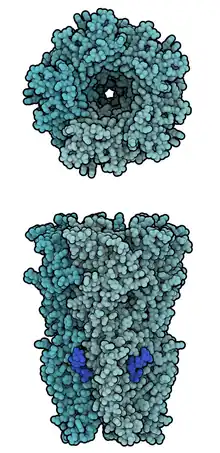
The antiparasitic drug ivermectin (shown here in royal blue) works by binding to glutamate-gated chloride channel receptors, a type of chloride channel found only in protostomes. It “locks” the receptor in an activated (open) conformation, allowing unrestricted passage of chloride (Cl−) ions into the cell, ultimately killing the parasite.[1] (Top view shows the open channel, with a central pore through which Cl− is transported; side view shows drug binding. From PDB: 3RHW.)
A chloride channel opener is a type of drug which facilitates ion transmission through chloride channels.
An example is 1,10-phenanthroline, which activates Cystic fibrosis transmembrane conductance regulator (CFTR) chloride channels.[2]
GABA-A receptor agonists (e.g. lorazepam) may also be considered chloride channel openers
See also
References
- ↑ Atif M, Estrada-Mondragon A, Nguyen B, Lynch JW, Keramidas A (October 2017). "Effects of glutamate and ivermectin on single glutamate-gated chloride channels of the parasitic nematode H. contortus". PLOS Pathog. 13 (10): e1006663. doi:10.1371/journal.ppat.1006663. PMC 5638611. PMID 28968469.
- ↑ Duszyk M, MacVinish L, Cuthbert AW (October 2001). "Phenanthrolines--a new class of CFTR chloride channel openers". British Journal of Pharmacology. 134 (4): 853–64. doi:10.1038/sj.bjp.0704328. PMC 1573018. PMID 11606326.
Further reading
- Cuthbert AW (February 2001). "Assessment of CFTR chloride channel openers in intact normal and cystic fibrosis murine epithelia". British Journal of Pharmacology. 132 (3): 659–68. doi:10.1038/sj.bjp.0703859. PMC 1572602. PMID 11159718.
- Ramteke VD, Tandan SK, Kumar D, Aruna Devi R, Shukla MK, Ravi Prakash V (January 2009). "Increased hyperalgesia by 5-nitro-2, 3-(phenylpropylamino)-benzoic acid (NPPB), a chloride channel blocker in crush injury-induced neuropathic pain in rats". Pharmacology Biochemistry and Behavior. 91 (3): 417–22. doi:10.1016/j.pbb.2008.08.017. PMID 18775743. S2CID 20051233.
This article is issued from Wikipedia. The text is licensed under Creative Commons - Attribution - Sharealike. Additional terms may apply for the media files.