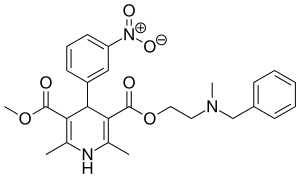
Nicardipine
 | |
| Names | |
|---|---|
| Trade names | Cardene, others |
| Other names | Nicardipine hydrochloride |
IUPAC name
| |
| Clinical data | |
| Drug class | Calcium channel blocker (dihydropyridine)[1] |
| Main uses | High blood pressure, heart related chest pain[1] |
| Side effects | Swelling, headache, palpations, low blood pressure[1] |
| WHO AWaRe | UnlinkedWikibase error: ⧼unlinkedwikibase-error-statements-entity-not-set⧽ |
| Routes of use | By mouth, intravenous |
| Onset of action | Within 15 min[2] |
| Duration of action | About 1 hr[2] |
| External links | |
| AHFS/Drugs.com | Monograph |
| MedlinePlus | a695032 |
| Legal | |
| Legal status |
|
| Pharmacokinetics | |
| Protein binding | >95% |
| Elimination half-life | 8.6 hours |
| Chemical and physical data | |
| Formula | C26H29N3O6 |
| Molar mass | 479.533 g·mol−1 |
| 3D model (JSmol) | |
| Melting point | 136–138 °C (277–280 °F) |
SMILES
| |
InChI
| |

Nicardipine, sold under the brand name Cardene among others, is a medication used to treat high blood pressure and heart related chest pain.[1] It is also used for Raynaud's phenomenon.[3] It is given by mouth and injected into a vein.[1]
Common side effects include swelling, headache, palpations, and low blood pressure.[1] It should not be used in those with severe aortic stenosis.[1] It may be used in pregnancy.[4] It is a calcium channel blocker of the dihydropyridine class.[1] It works by dilating peripheral arteries.[1]
Nicardipine was patented in 1973 and first approved for medical use in 1981.[5] It was approved in the United States in 1988.[1] It is available as a generic medication.[4] In the United Kingdom 4 weeks of medication costs the NHS about £10 as of 2021.[4] In the United States this amount costs about 130 USD.[6]
Medical uses
It has been used in percutaneous coronary intervention.[7]
Dosage
For angina or high blood pressure it is used at a dose of 20 to 30 mg three times per day.[4]
For a hypertensive emergency it is often started at a dose of 5 mg/hr as an intravenous infusion.[4][2] This may be increased by 2.5 mg/hr every half hour up to 15 mg/hr.[2]
Society and culture
The patent for both Cardene and Cardene SR expired in October 1995.[8]
References
- 1 2 3 4 5 6 7 8 9 10 "Nicardipine Monograph for Professionals". Drugs.com. Archived from the original on 21 September 2021. Retrieved 12 November 2021.
- 1 2 3 4 "Hypertensive emergency". EMCrit Project. Archived from the original on 8 July 2023. Retrieved 21 May 2024.
- ↑ Pope, J (10 October 2013). "Raynaud's phenomenon (primary)". BMJ clinical evidence. 2013: 1119. PMID 24112969.
- 1 2 3 4 5 BNF 81: March-September 2021. BMJ Group and the Pharmaceutical Press. 2021. p. 176. ISBN 978-0857114105.
- ↑ Fischer, Jnos; Ganellin, C. Robin (2006). Analogue-based Drug Discovery. John Wiley & Sons. p. 464. ISBN 9783527607495. Archived from the original on 2021-08-29. Retrieved 2021-09-18.
- ↑ "Nicardipine Prices, Coupons & Patient Assistance Programs". Drugs.com. Archived from the original on 22 September 2021. Retrieved 13 November 2021.
- ↑ Huang RI, Patel P, Walinsky P, et al. (November 2006). "Efficacy of intracoronary nicardipine in the treatment of no-reflow during percutaneous coronary intervention". Catheterization and Cardiovascular Interventions. 68 (5): 671–6. doi:10.1002/ccd.20885. PMID 17034064. S2CID 37071966.
- ↑ "Nicardipine at Medline PLus". Archived from the original on 2016-07-05. Retrieved 2021-09-18.
External links
| Identifiers: |
|---|