| Darga | |||||||
|---|---|---|---|---|---|---|---|
| |||||||
| cantillation | |||||||
| Sof passuk | ׃ | paseq | ׀ | ||||
| etnakhta/atnakh | ֑ | segol | ֒ | ||||
| shalshelet | ֓ | zaqef qaton | ֔ | ||||
| zaqef gadol | ֕ | tifcha/tarkha | ֖ | ||||
| rivia/ravia’ | ֗ | zarqa | ֘ | ||||
| pashta | ֙ | yetiv | ֚ | ||||
| tevir | ֛ | geresh/gerish | ֜ | ||||
| geresh muqdam | ֝ | gershayim/shenei gerishin | ֞ | ||||
| karnei pharah | ֟ | telisha gedola/talsha | ֠ | ||||
| pazer (gadol) | ֡ | atnah hafukh | ֢ | ||||
| munakh/shofar holekh | ֣ | mahapakh/shofar mehupakh | ֤ | ||||
| merkha/ma’arikh | ֥ | merkha kefula/terei ta’amei | ֦ | ||||
| darga | ֧ | qadma | ֨ | ||||
| telisha qetana/tarsa | ֩ | yerah ben yomo | ֪ | ||||
| ole | ֫ | illuy | ֬ | ||||
| dehi | ֭ | zinor | ֮ | ||||
Darga (Hebrew: דַּרְגָּא) is a cantillation mark commonly found in the Torah, Haftarah, and other books. The symbol for the darga resembles a backwards Z.[1]
The darga is usually followed by a Tevir.[2] It is most often found in places where a Tevir clause has two words which are closely related.[3] The Hebrew word דַּרְגָּא translates into English as step. With the Hebrew word tevir meaning "broken," the combination of darga tevir means "broken step."
Darga can also be followed by a Munach Rivia,[4] and can (rarely) be followed by a Mercha Kefula, an altogether rare trope.[5]
Total occurrences
| Book | Number of appearances |
|---|---|
| Torah | 1091[6] |
| Genesis | 253[6] |
| Exodus | 221[6] |
| Leviticus | 171[6] |
| Numbers | 237[6] |
| Deuteronomy | 209[6] |
| Nevi'im | 710[7] |
| Ketuvim | 637[7] |
Melody
The Ashkenazic darga is recited in a fast, downward slope, as follows:
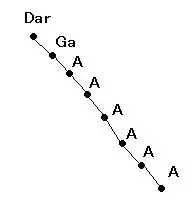
The Sefardic darga is ascending, and the Moroccan darga is descending with a waver in the middle.[8]
References
- ↑ Chanting the Hebrew Bible By Joshua R. Jacobson, page 45
- ↑ Chanting the Hebrew Bible By Joshua R. Jacobson, page 113
- ↑ Chanting the Hebrew Bible By Joshua R. Jacobson, page 168
- ↑ Chanting the Hebrew Bible By Joshua R. Jacobson, pages 102-03
- ↑ Chanting the Hebrew Bible By Joshua R. Jacobson, page 111
- 1 2 3 4 5 6 Concordance of the Hebrew accents in the Hebrew Bible: Concordance ..., Volume 1 By James D. Price, page 6
- 1 2 Concordance of the Hebrew accents in the Hebrew Bible: Concordance ..., Volume 1 By James D. Price, page 5
- ↑ "טעמי מקרא".